1.9k words | Dan Hollick
Blending modes.
Blending modes are small mathematical functions that decide how source and destination pixels combine.
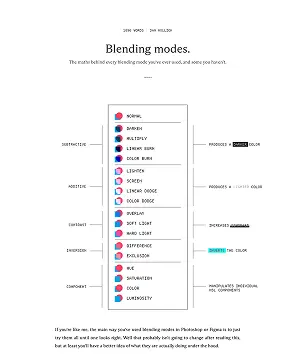
Blending modes are small mathematical functions that decide how source and destination pixels combine. The apparent simplicity comes from a set of carefully chosen representations, transformations and physical assumptions working together.
Pixel arithmetic
Multiply darkens by combining channel values, while Screen performs an inverse operation that brightens.
This is one part of a longer chain: source pixel becomes destination becomes blend function becomes result. The useful abstraction hides the physical work, but the underlying constraints still shape the software built above it.
Alpha
Opacity describes coverage and must be combined carefully to avoid dark fringes and halos.
The implementation is full of compromises. Precision, speed, storage and energy rarely improve together, so practical systems choose the errors people are least likely to notice.
Premultiplication
Storing colour channels already multiplied by alpha makes compositing more stable and efficient.
Once this layer is visible, familiar design conventions stop looking arbitrary. They are accumulated responses to the capabilities and limits of the machinery below.
A visual study based on the original chapter. Text is condensed and rewritten.