2.8k words | Dan Hollick
Color contrast.
Contrast is not a property of two hex values alone: perception changes with type weight, size, surroundings and the display itself.
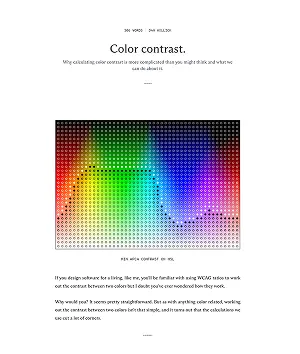
Contrast is not a property of two hex values alone: perception changes with type weight, size, surroundings and the display itself. The apparent simplicity comes from a set of carefully chosen representations, transformations and physical assumptions working together.
Relative luminance
Contrast formulas estimate the brightness difference between foreground and background colours.
This is one part of a longer chain: foreground becomes background becomes visual system becomes judgement. The useful abstraction hides the physical work, but the underlying constraints still shape the software built above it.
Context matters
Thin strokes, glare, local adaptation and colour vision differences change what remains legible.
The implementation is full of compromises. Precision, speed, storage and energy rarely improve together, so practical systems choose the errors people are least likely to notice.
Design beyond a score
Automated thresholds are a baseline; real interfaces still need perceptual testing.
Once this layer is visible, familiar design conventions stop looking arbitrary. They are accumulated responses to the capabilities and limits of the machinery below.
A visual study based on the original chapter. Text is condensed and rewritten.