Planned chapter | Dan Hollick
Quantum computing.
Quantum computers manipulate probability amplitudes so carefully designed interference makes useful answers more likely when qubits are measured.
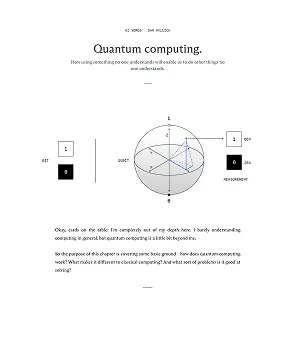
The source chapter is still planned. This route preserves the collection and offers an original conceptual preview.
Quantum computers manipulate probability amplitudes so carefully designed interference makes useful answers more likely when qubits are measured. The apparent simplicity comes from a set of carefully chosen representations, transformations and physical assumptions working together.
Superposition
A qubit carries amplitudes for two basis states until measurement produces a classical result.
This is one part of a longer chain: qubits becomes gates becomes interference becomes measurement. The useful abstraction hides the physical work, but the underlying constraints still shape the software built above it.
Entanglement
Joint quantum states can encode correlations that cannot be separated into independent qubits.
The implementation is full of compromises. Precision, speed, storage and energy rarely improve together, so practical systems choose the errors people are least likely to notice.
Algorithms
Speedups come from arranging interference around a problem structure, not trying every answer at once.
Once this layer is visible, familiar design conventions stop looking arbitrary. They are accumulated responses to the capabilities and limits of the machinery below.
A visual study based on the original chapter. Text is condensed and rewritten.