5.4k words | Dan Hollick
Image compression.
Image codecs save space by transforming pixels into signals that separate visually important structure from details the eye is likely to miss.
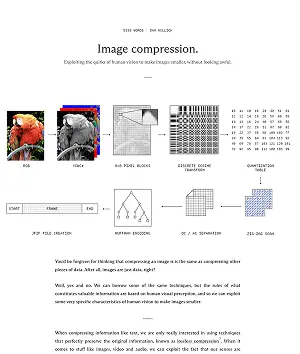
Image codecs save space by transforming pixels into signals that separate visually important structure from details the eye is likely to miss. The apparent simplicity comes from a set of carefully chosen representations, transformations and physical assumptions working together.
Chroma subsampling
Human vision tolerates lower colour detail than brightness detail.
This is one part of a longer chain: pixels becomes transform becomes quantise becomes bitstream. The useful abstraction hides the physical work, but the underlying constraints still shape the software built above it.
Frequency transforms
Blocks become combinations of smooth and rapidly changing patterns.
The implementation is full of compromises. Precision, speed, storage and energy rarely improve together, so practical systems choose the errors people are least likely to notice.
Quantisation
Small or visually unimportant coefficients are stored with less precision or removed.
Once this layer is visible, familiar design conventions stop looking arbitrary. They are accumulated responses to the capabilities and limits of the machinery below.
A visual study based on the original chapter. Text is condensed and rewritten.