Planned chapter | Dan Hollick
Cryptography.
Cryptography uses deliberately difficult mathematical problems to provide confidentiality, integrity and proof of identity.
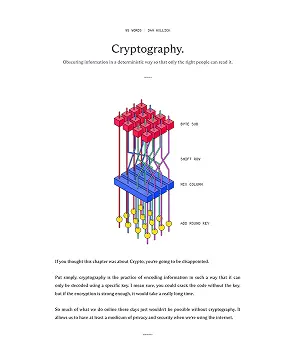
The source chapter is still planned. This route preserves the collection and offers an original conceptual preview.
Cryptography uses deliberately difficult mathematical problems to provide confidentiality, integrity and proof of identity. The apparent simplicity comes from a set of carefully chosen representations, transformations and physical assumptions working together.
Symmetric keys
One shared secret can encrypt large amounts of data efficiently.
This is one part of a longer chain: message becomes keyed transform becomes ciphertext becomes verified output. The useful abstraction hides the physical work, but the underlying constraints still shape the software built above it.
Public keys
A paired public and private key enables secure exchange and digital signatures.
The implementation is full of compromises. Precision, speed, storage and energy rarely improve together, so practical systems choose the errors people are least likely to notice.
Hashes
One-way fingerprints expose accidental or malicious changes without revealing the original input.
Once this layer is visible, familiar design conventions stop looking arbitrary. They are accumulated responses to the capabilities and limits of the machinery below.
A visual study based on the original chapter. Text is condensed and rewritten.