2.0k words | Dan Hollick
Rays and SDFs.
Rays ask where a line meets a scene; signed distance fields answer how far any point is from the nearest surface.
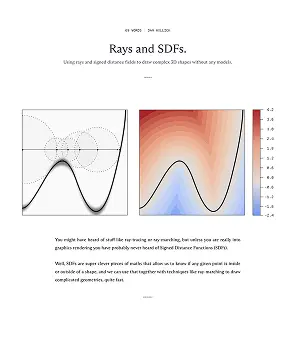
Rays ask where a line meets a scene; signed distance fields answer how far any point is from the nearest surface. The apparent simplicity comes from a set of carefully chosen representations, transformations and physical assumptions working together.
Intersections
Analytic shapes can be solved directly, while complex scenes need acceleration structures.
This is one part of a longer chain: camera ray becomes distance samples becomes surface hit becomes normal + light. The useful abstraction hides the physical work, but the underlying constraints still shape the software built above it.
Ray marching
Distance estimates let a ray advance safely through empty space in large steps.
The implementation is full of compromises. Precision, speed, storage and energy rarely improve together, so practical systems choose the errors people are least likely to notice.
Normals
The gradient around a surface reveals its orientation for lighting.
Once this layer is visible, familiar design conventions stop looking arbitrary. They are accumulated responses to the capabilities and limits of the machinery below.
A visual study based on the original chapter. Text is condensed and rewritten.