6.0k words | Dan Hollick
How to make a font.
A font is a coordinated system of outlines, spacing rules, substitutions and metrics—not just a folder of letters.
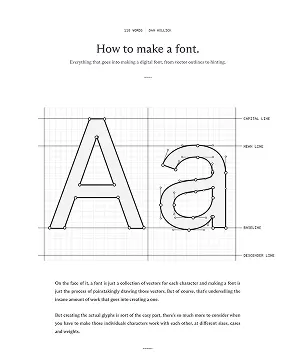
A font is a coordinated system of outlines, spacing rules, substitutions and metrics—not just a folder of letters. The apparent simplicity comes from a set of carefully chosen representations, transformations and physical assumptions working together.
Glyphs
Characters map to one or more drawn forms, each built from vector contours.
This is one part of a longer chain: glyph outline becomes metrics becomes shaping becomes rendered text. The useful abstraction hides the physical work, but the underlying constraints still shape the software built above it.
Spacing
Advance widths and kerning determine the rhythm between neighbouring shapes.
The implementation is full of compromises. Precision, speed, storage and energy rarely improve together, so practical systems choose the errors people are least likely to notice.
Shaping
Text engines select and position glyphs for scripts, ligatures and contextual forms.
Once this layer is visible, familiar design conventions stop looking arbitrary. They are accumulated responses to the capabilities and limits of the machinery below.
A visual study based on the original chapter. Text is condensed and rewritten.