3.7k words | Dan Hollick
How the internet works.
The internet is a network of networks that forwards addressed packets hop by hop while higher layers provide names, reliability and security.
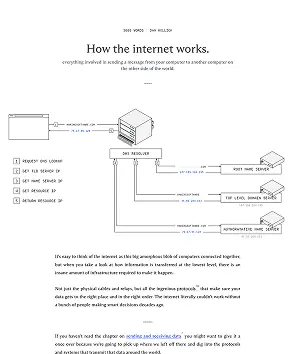
The internet is a network of networks that forwards addressed packets hop by hop while higher layers provide names, reliability and security. The apparent simplicity comes from a set of carefully chosen representations, transformations and physical assumptions working together.
IP
Addresses and routing rules let packets cross independently operated networks.
This is one part of a longer chain: domain name becomes IP packet becomes routers becomes server. The useful abstraction hides the physical work, but the underlying constraints still shape the software built above it.
TCP and QUIC
Transport protocols recover loss, order data and adapt to congestion.
The implementation is full of compromises. Precision, speed, storage and energy rarely improve together, so practical systems choose the errors people are least likely to notice.
DNS
A distributed directory translates human-readable names into network addresses.
Once this layer is visible, familiar design conventions stop looking arbitrary. They are accumulated responses to the capabilities and limits of the machinery below.
A visual study based on the original chapter. Text is condensed and rewritten.