Planned chapter | Dan Hollick
Compilers and interpreters.
Compilers translate programs ahead of time; interpreters execute representations directly, with modern runtimes often combining both strategies.
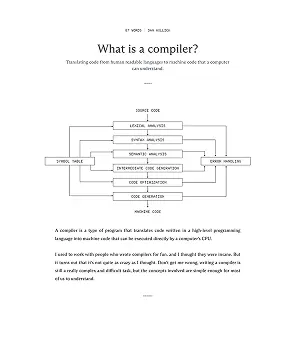
The source chapter is still planned. This route preserves the collection and offers an original conceptual preview.
Compilers translate programs ahead of time; interpreters execute representations directly, with modern runtimes often combining both strategies. The apparent simplicity comes from a set of carefully chosen representations, transformations and physical assumptions working together.
Front end
Lexing, parsing and type checking turn text into a verified program representation.
This is one part of a longer chain: source becomes parse becomes intermediate form becomes execute. The useful abstraction hides the physical work, but the underlying constraints still shape the software built above it.
Optimisation
Equivalent transformations remove redundant work and expose efficient machine operations.
The implementation is full of compromises. Precision, speed, storage and energy rarely improve together, so practical systems choose the errors people are least likely to notice.
Execution
Code may become a native binary, bytecode for a virtual machine or instructions evaluated on demand.
Once this layer is visible, familiar design conventions stop looking arbitrary. They are accumulated responses to the capabilities and limits of the machinery below.
A visual study based on the original chapter. Text is condensed and rewritten.