3.2k words | Dan Hollick
Boolean operations.
Union, intersection and subtraction turn overlapping vector outlines into new shapes by classifying regions and rebuilding their boundaries.
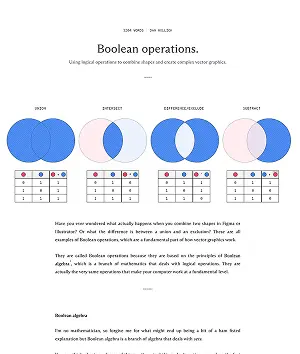
Union, intersection and subtraction turn overlapping vector outlines into new shapes by classifying regions and rebuilding their boundaries. The apparent simplicity comes from a set of carefully chosen representations, transformations and physical assumptions working together.
Winding rules
Software needs a consistent test for deciding whether a point falls inside a complex path.
This is one part of a longer chain: two paths becomes intersections becomes inside / outside becomes new outline. The useful abstraction hides the physical work, but the underlying constraints still shape the software built above it.
Intersections
Every crossing splits contours into segments that can be classified and recombined.
The implementation is full of compromises. Precision, speed, storage and energy rarely improve together, so practical systems choose the errors people are least likely to notice.
Topology
Coincident edges, tiny gaps and self-intersections make robust geometry surprisingly difficult.
Once this layer is visible, familiar design conventions stop looking arbitrary. They are accumulated responses to the capabilities and limits of the machinery below.
A visual study based on the original chapter. Text is condensed and rewritten.